



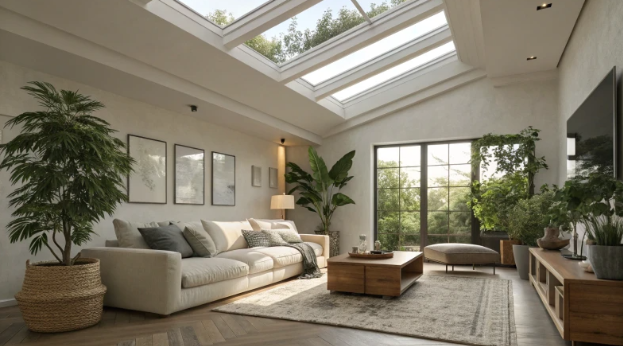
Walk into a home with a skylight above the kitchen bench and something registers before you can name it. The colours look right. Shadows aren’t fighting the furniture. There’s a quality to the light that wall windows never quite manage, and most people can’t explain why — they just know the room feels better. Skyspan skylights have built their reputation exactly this way. Not through promises, but through what people notice after living with one for a few weeks.
The Flat Light Problem
Side windows are directional. Light comes in from one angle, hits one half of the room, and leaves the other half to manage on its own. People respond adding lamps, going lighter with paint colours, pulling curtains back as far as they’ll go. Sometimes it helps a little. Often it doesn’t. The problem isn’t how much light a room gets — it’s where that light is coming from. Overhead light spreads differently. It reaches corners, lifts floor surfaces, and changes how a space reads at two in the afternoon just as much as it does at nine in the morning.
Where Savings Actually Come From
Nobody is promising enormous figures here. What actually happens is simpler. There’s a long stretch in the middle of every day when households run lights purely out of habit — not because the rooms are dark, but because switching them on became automatic. A skylight above a hallway or a south-facing bathroom breaks that habit. The switch doesn’t get touched. Across every day of the year, that consistency becomes something genuinely felt, without any effort attached to it.
What It Does to Sleep
Most people don’t expect this one. A bedroom skylight — with proper glazing that manages UV without cutting out the full light spectrum — lets the room shift through the day the way the outside world does. Light in the morning is different from light at midday, which is different again late afternoon. The body reads those changes. Melatonin and cortisol respond to them. Artificial lighting runs flat all day and the body gets no signal. People sleeping in naturally lit rooms often find mornings easier without changing anything else about their routine.
Ventilation People Forget About
Skyspan skylights with operable openings use physics that needs no explanation beyond the basics. Warm air rises, finds the opening, and leaves. Cooler air pulls in through lower windows to replace it. On a hot Australian afternoon — especially upstairs — that movement makes a room feel different within minutes. No compressor noise, no running costs, no maintenance schedule. It’s a principle that’s been used in buildings for centuries and it works just as well in a suburban home as it ever did anywhere else.
What Architectural Appeal Actually Means
It’s a phrase that gets thrown around without much behind it, so here’s what it actually looks like. A skylight changes where the eye goes. In most rooms, gaze stays horizontal — across walls, along benchtops, toward furniture. Put a skylight above a dining table or at the far end of a corridor and suddenly the room has a vertical dimension it didn’t seem to have before. It feels taller. More considered. Skyspan skylights are sized to work within standard roof pitches, which means achieving that effect doesn’t require structural work in most homes.
Small Rooms Gain the Most
Bathrooms and laundries make the clearest argument. No external windows, artificial light running every time someone walks in, spaces that feel closed off from the rest of the home. One skylight changes all of that. Above a shower or a laundry bench, it stops the room feeling like an afterthought and starts making it feel like somewhere the rest of the house connects to.
Why Australian Conditions Matter
UV levels here aren’t comparable to most other places. A product that handles a European climate adequately may allow serious heat gain and UV penetration in an Australian setting — damaging furnishings, warming rooms unnecessarily, wearing materials down faster. Glazing choices matter here more than anywhere. Low-e coatings and laminated glass manage both solar heat gain and UV transmission in ways basic acrylic simply doesn’t. Products built for Australian conditions start there, without treating it as an upgrade.
Conclusion
Homes that feel genuinely comfortable to live in usually have one thing in common — somebody thought carefully about light. Skyspan skylights address the gaps that Australian residential design tends to leave: dark corridors, windowless bathrooms, rooms that lamps never quite fix. When the right product goes in the right spot, people stop noticing it as a feature. The space just feels the way a room should feel, and that’s the whole point.