


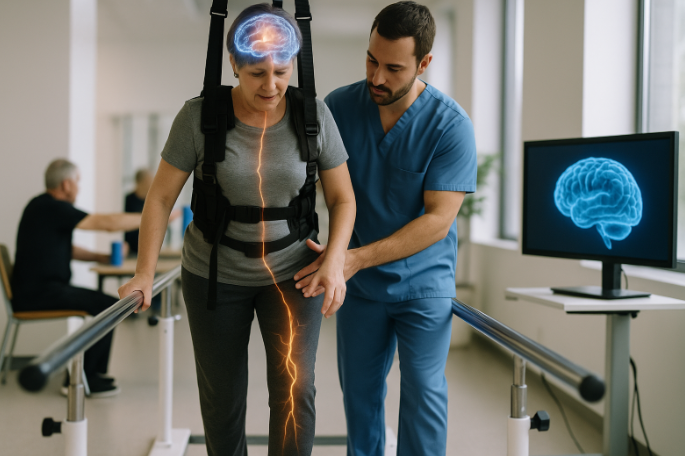
Recovery from a neurological event rarely follows a straight line. Someone might regain the ability to walk short distances within weeks of a stroke, only to find that climbing stairs, carrying something while walking, or walking on uneven ground remains genuinely difficult months later. Families often describe this as confusing — the person seems “mostly better,” yet certain things that should logically follow from being mostly better simply have not returned. A neurological physiotherapist works in exactly this space, where the gap between general recovery and functional independence often requires a kind of attention that general rehabilitation does not provide.
Why the Brain Relearns Differently to the Body
Recovering strength in a muscle and recovering the brain’s ability to coordinate that muscle correctly are not the same process, even though they often get treated as though they are. After conditions like stroke, brain injury, or certain neurological diseases, a limb might have adequate strength while the signals telling it how to move — timing, sequencing, coordination with other muscle groups — remain disrupted. This is why someone can sometimes lift their arm just fine when asked to in isolation, but struggle to use that same arm naturally during an everyday task that requires it to work alongside other movements without conscious thought.
The Walking Pattern That Looks Fine From a Distance
Gait alterations following neurological diseases are typically mild enough that they go overlooked by persons who are not explicitly seeking for them. Someone could walk at a regular speed, cover normal distances, and seem to have recovered well – while compensating in ways that inflict continuous pressure on joints, raise fall risk in specific circumstances, or just expend substantially more energy than walking should take. A neurological physiotherapist trained to analyse gait in detail may discover these compensations even when the general walking pattern seems normal to a casual observer, and correcting them early typically eliminates subsequent disorders that emerge after years of compensatory movement.
Why Fatigue Is Part of the Clinical Picture, Not a Separate Issue
Fatigue following neurological conditions is often profound and qualitatively different from ordinary tiredness, yet it is sometimes treated as a separate problem from the physical rehabilitation itself — something to simply “manage” alongside therapy rather than something therapy needs to account for. In reality, fatigue affects how the nervous system responds to rehabilitation exercises, how much benefit a person gets from a session, and how quickly that benefit fades. A neurological physiotherapist who understands fatigue as part of the clinical picture paces rehabilitation accordingly — recognizing when pushing harder produces less progress, not more, and adjusting sessions to work with the nervous system’s actual capacity rather than against it.
How Environment Shapes What “Recovery” Actually Looks Like
A person might move confidently and safely within a familiar clinical setting — flat floors, good lighting, no distractions — and then struggle considerably in their own home, where rugs, steps, low lighting, and the simple unpredictability of daily life create challenges that a clinical environment does not replicate. Rehabilitation that takes place entirely in a controlled setting can produce results that do not transfer well to real life, not because the rehabilitation was ineffective, but because the environments are genuinely different in ways that matter for neurological conditions specifically. Therapy that incorporates real-world environments, or at least considers them explicitly, tends to produce gains that hold up once someone returns to their actual daily routine.
The Long Timeline That Families Are Rarely Prepared For
Neurological recovery often continues, in smaller and less dramatic ways, for far longer than the initial recovery period that most people expect. The dramatic early gains that happen in the weeks following an event give way to a much slower, more gradual phase — one that can still produce meaningful improvement, but requires a different kind of patience and a different rhythm of therapy. Families who expect recovery to plateau quickly sometimes disengage from ongoing therapy at exactly the point where continued, focused input can still make a genuine difference, simply because nobody explained that this slower phase was a normal and valuable part of the process.
Conclusion
A neurological physiotherapist brings a depth of understanding to recovery that goes well beyond strength and movement in isolation — addressing coordination, fatigue, environment, and the realistic timeline of neurological recovery as connected parts of the same picture. For anyone navigating recovery from a neurological condition, or supporting someone who is, speaking with a qualified professional who specialises in this area can make a meaningful difference to both progress and confidence over time.