


Most window treatment decisions get made twice. The first time happens when a home is newly furnished and something needs to go on the windows quickly. The second time happens when that first choice starts failing — sagging, warping, yellowing, or simply looking tired well before it should. That second decision is slower and more honest. It accounts for what the first one ignored. Aluminium plantation shutters tend to appear at this stage, not because they are fashionable, but because they quietly solve the problems that brought the homeowner back to the decision in the first place.
Powder Coat Is Not Paint
Paint sits on a surface. That is the whole relationship — adhesion between two separate things. Powder coat works differently. It is electrostatically applied and then heat-cured, which fuses it into the aluminium at a level that bonding alone cannot achieve. Salt air and UV exposure attack painted finishes from beneath over time, working up through microscopic imperfections until bubbling and peeling become visible. There is nothing to work beneath on a powder-coated surface. The finish and the material are effectively one thing. Coastal homeowners who understand this distinction make very different product choices from those who do not.
Louvre Tension Reveals Quality
How louvres behave after years of daily use is the real measure of a shutter’s quality. Timber expands and contracts with humidity and temperature. That constant movement works on the tension mechanism gradually, until louvres no longer hold their set angle and begin drooping between adjustments. It is a slow change. Most people do not notice it happening until the shutter looks and operates nothing like it did at installation. Aluminium plantation shutters do not follow this pattern. Thermal movement in aluminium is minimal. A louvre set to a specific angle holds that angle — season after season, without fuss.
Thermal Performance Needs Understanding
Opening shutters in summer and closing them in winter captures almost none of what these products actually offer thermally. Louvres angled upward during summer push incoming sunlight toward the ceiling rather than across the floor. Radiant heat at occupant level drops. Airflow and daylight stay intact. Reversed in winter, the same logic captures low-angle sun and directs warmth into the room. No running costs. No technology involved. Just louvre angle working with the sun’s seasonal position — a detail most installers never explain and most homeowners never discover until they research it themselves.
Frame Depth Changes Everything
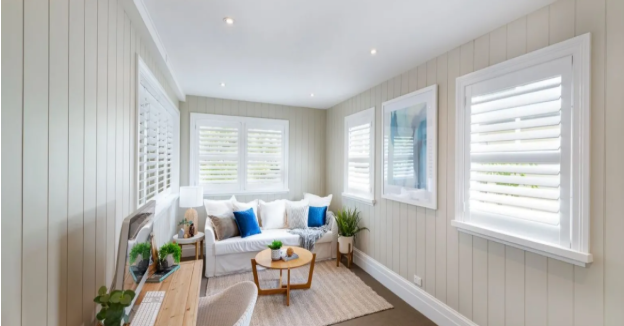
A shutter frame that sits proud of the window reveal rather than sitting flush within it creates a visual gap that reads as an afterthought rather than a deliberate finish. It is a small thing that becomes more noticeable over time. Aluminium plantation shutters fabricated to recess properly into the reveal integrate with the surrounding architecture in a way face-mounted frames simply cannot replicate. The flush fit also reduces the perimeter gap around the shutter, which improves light control and limits sound transmission through the opening — something that matters considerably in street-facing rooms and bedrooms near noise.
Wide Louvres Feel Different
Louvre width is not a purely aesthetic choice. Wider louvres obstruct less glass when open, which preserves more of the view and allows more light into the room when privacy is not the priority. In rooms that face a garden, water, or a streetscape worth looking at, this difference is significant. Wide louvres in aluminium open to near-full transparency. The same width in timber or PVC tends to bow visibly under its own weight, which affects both appearance and how the tension mechanism holds up over time. Material rigidity is what makes wide louvres work properly — and aluminium has it.
Panel Splitting Solves Problems
One shutter panel across a large opening becomes harder to operate as the opening gets wider. Hinges take more stress. The panel feels heavy and awkward. Splitting the same opening into multiple independently hinged panels fixes this without changing the appearance of the installation from a distance. Each panel operates on its own. Partial window access becomes possible without moving the whole shutter. Experienced installers raise this at the specification stage. Those who do not leave homeowners with installations that technically work and practically frustrate — every single day.
Conclusion
Aluminium plantation shutters hold up across the conditions that reveal the weaknesses in other materials — salt air, persistent humidity, strong UV, and the daily wear of louvres adjusted repeatedly throughout the day. The qualities that make them worth choosing are in the material and the fabrication, not the finish catalogue. For homeowners thinking beyond the short term, aluminium plantation shutters remain the most straightforward and durable window treatment choice the Australian market consistently offers.